
Moving up, Moving Green
Long-term mountain systems monitoring with a local tourism operator
Professor John Pomeroy
University of Saskatchewan Centre for Hydrology
Twelve years ago, we noticed that the snowpack at our Coldwater Lab's Global Water Futures Observatory sites at lower elevations in the well-studied Marmot Creek Research Basin had begun to decline. Our measurements and observations were key to predicting the amount of water that flows down from the Canadian Rockies to the Canadian Prairies via the Saskatchewan River system, sustaining crops, cities, industry, lakes, deltas and key ecosystems. But to continue our observations, we needed to move higher – almost one kilometre of sheer rock higher -- to where the deep snow remained. How to get our equipment and scientists up there often enough, and over the longer term?
One evening in Canmore, an Alberta destination for skiing tourism, I ran into a local businessman who was interested in developing a sustainable ski operation: a 'green' skiing and resort experience. As we chatted about our very different work lives, it became clear that we had a common set of interests and values when it came to mountains. "It would be great", he said, "if our green ski resort had an ongoing relationship with scientists who were studying the snow and water around our lodge and trails. The information they collected could help us plan our operations, and would also be useful in their scientific work." We agreed to continue our conversation later.
Several weeks later I received a phone call. His company had decided to acquire a lease for the old ski resort facilities around an iconic mountain called 'The Fortress' to begin fulfilling his vision of a sustainable ski lodge. "Would you like to come up and have a look?" Our Coldwater Lab team didn't hesitate. I had conducted research there before, in 1991 when the ski hill was still operating and knew the snowfall there was deeper and the snowpacks more reliable than in other parts of the Kananaskis Valley. The Fortress Mountain site is at 2500 metres elevation, and is surrounded by, but outside the boundaries of provincial parklands. It has an access road to high elevations, safety teams on site, wonderful people working there and many facilities still intact.
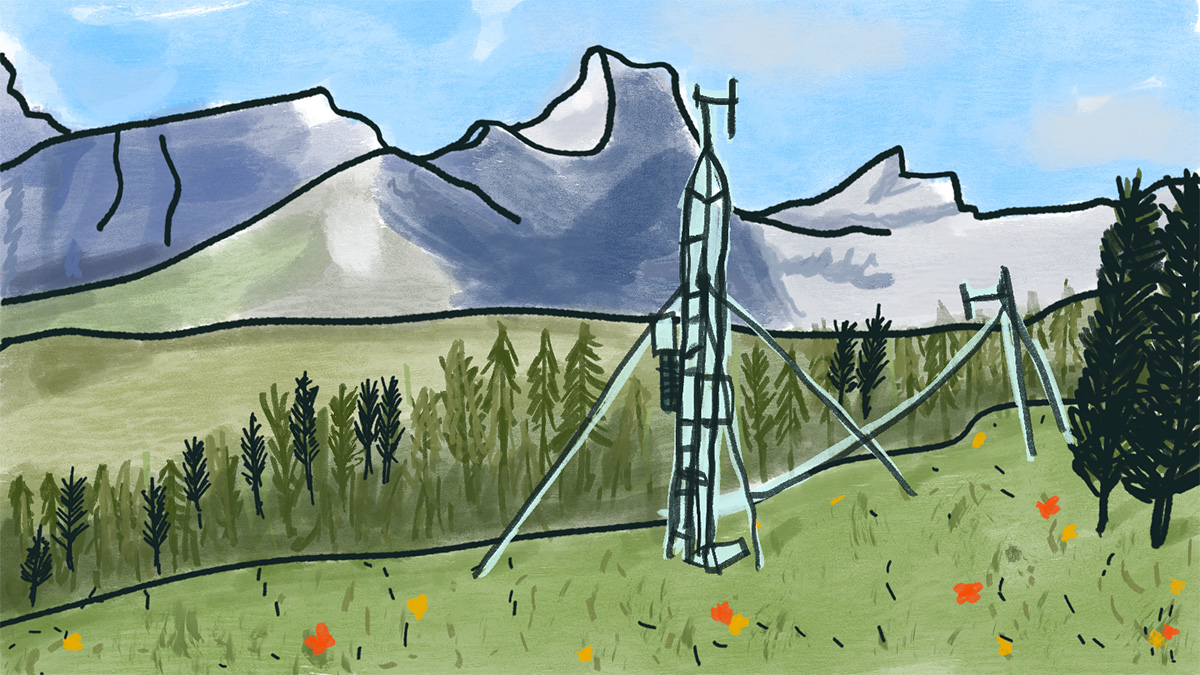
Within six months we had set up seven snow and weather monitoring stations that measured the accumulation and melt of snow in great detail on mountain ridgetops, subalpine forests and in deep drift locations. We then added streamflow gauges and colleagues Cherie Westbrook from the University of Saskatchewan, Masaki Hayashi from the University of Calgary, Julie Theriault from the Université du Québec à Montréal, and Rich Petrone from University of Waterloo joined us to study wetlands, groundwater, snow storms and forests. The private business provides a year-round caretaker onsite who has become a good friend and mentor to our students, and access to logistical support that can be used to help move our heavy scientific equipment around. We have run major experiments on storms over the continental divide, we have visualized the detailed 'dance' of blowing snow particles during a blizzard with a high intensity laser and high-speed camera, we have figured out how groundwater feeds alpine lakes and how subalpine forests draw on groundwater reserves during droughts, and this is where we map snow depth and deep drifts using our drone with a laser. We have even weighed a hanging tree to see how much snow is held in the forest canopy. The site is a cold regions water science gold mine. While the business begins its re-development process with guided skiing, we are able to provide current data about snowfall, snow depths, winds, and temperatures that helps the operator stay aware of risks, and that, back in Canmore, feeds our models that will in turn feed our hydrological predictions. What is, for us, a model testbed and outdoor snow and water science laboratory, is a place of outdoor delight, fresh air, and superb skiing for others. Partnerships like this are essential to long-term scientific studies.
And they often begin with a simple conversation.
Further reading:
Schirmer, M., and Pomeroy, J.W. (2020). Processes governing snow ablation in alpine terrain- detailed measurements from the Canadian Rockies. Hydrology and Earth System Sciences, 24(1): 143-157, DOI: 10.5194/hess-24-143-2020.
Aksamit, N O., and Pomeroy, J W. (2018). Scale interactions in turbulence for mountain blowing snow. Journal of Hydrometeorology, 19(2): 305-320, DOI: 10.1175/JHM-D-17-0179.1.